




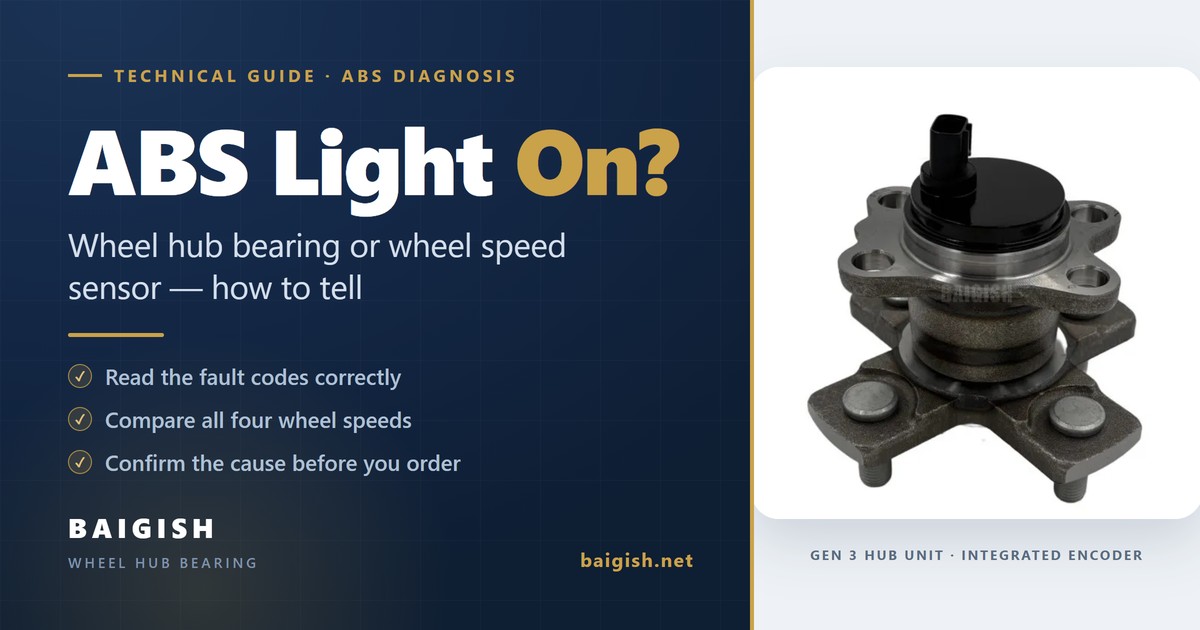
The ABS light comes on, the scanner says "left front wheel speed sensor", the workshop fits a new sensor, and two weeks later the light is back. In a large share of these comebacks the sensor was never the problem. The signal it was reading had already been destroyed by a wheel hub bearing whose encoder ring had worn, cracked or drifted out of its air gap.
For distributors and importers this matters commercially, not just technically. A customer who buys a sensor, fits it, fails, and then buys a hub unit has paid twice and trusts the catalogue less. Knowing how to separate a bearing fault from a sensor fault is what lets you recommend the right part the first time — and it is the question behind most ABS-related enquiries that reach a bearing supplier.
This guide explains what the ABS light is really reporting, how a bearing corrupts the speed signal, which codes point at a bearing rather than a sensor, and a test sequence that settles the question before anything is ordered.
1. What the ABS Light Is Actually Telling You
The ABS module does not monitor the bearing. It monitors the speed signal arriving from each wheel and compares the four values against each other, against vehicle speed and against a plausibility model. When one corner disagrees with the other three, the module stores a fault, switches ABS off and lights the warning lamp. The bearing is only ever the suspected cause, never the reported one.
That single fact explains most misdiagnosis. The code names the circuit that produced an implausible signal. It does not name the component that caused the signal to become implausible. Between the wheel and the module there are five links in the chain:
- The encoder ring — a magnetic rubber ring or a toothed steel ring, mounted on the bearing seal or the hub flange
- The sensor — Hall-effect or magnetoresistive on modern vehicles, inductive on older ones
- The air gap between sensor tip and encoder, typically 0.5–1.5 mm
- The harness and its connector, exposed to salt, water and flexing at the knuckle
- The module and its software calibration
A bearing fault almost always attacks the first and third links. A sensor fault attacks the second. Wiring faults attack the fourth. The test sequence in section 4 walks that chain in order, cheapest and most likely first.
2. How a Worn Bearing Destroys the Speed Signal
A Generation 2 or Generation 3 hub unit carries its encoder ring on the sealed bearing itself. The ring is a rubber-bonded magnet with alternating north and south poles — typically 48 or 96 pole pairs — moulded onto the seal carrier or the inner race. As the wheel turns, the sensor counts the pole transitions and converts them into a square wave. The module reads frequency for speed and edge consistency for quality.
Three failure modes follow from that construction.
Play changes the air gap. As bearing raceways wear, the hub develops axial and radial movement. The encoder ring moves with it, so the gap between ring and sensor tip rises and falls once per revolution. The signal amplitude swings with it. Once the gap exceeds roughly 2 mm the sensor stops switching altogether, and the module sees a dropout that appears as a wheel that briefly stops turning while the other three keep reporting 80 km/h.
Contamination destroys the pole pattern. When the bearing seal degrades, grease escapes and water and ferrous debris enter. Metal particles collect on the encoder ring and bridge adjacent poles, blurring the north-south transitions. The sensor still produces a signal, but the edges become irregular and the module logs a signal-quality or plausibility fault rather than a circuit fault. This is the failure that produces an intermittent light for months before anything hard fails.
Mechanical damage removes poles. A ring that has cracked, swollen with rust or lost a segment produces a repeating dropout at one point in every revolution. On live data the wheel speed will dip at a fixed frequency proportional to road speed — a signature no sensor fault can reproduce.
Older vehicles using a passive inductive sensor and a toothed tone ring on the CV joint or hub flange fail differently: the ring itself corrodes or the teeth chip. The diagnostic logic is the same, but the ring is a separate part and can sometimes be replaced on its own.
3. Which Codes Point at a Bearing
Code numbering differs between manufacturers, but the pattern does not. What separates a bearing from a sensor is not the code number — it is whether the code describes a circuit fault or a signal fault, and whether it returns to the same corner after clearing.
| Code pattern | What the module is reporting | Bearing likelihood |
|---|---|---|
| Circuit open / short (e.g. the C0035–C0050 family on many GM applications) | No electrical continuity, or a short to ground or voltage at the sensor wiring | Low — this is a wiring or sensor failure. Start at the connector |
| Signal range / performance | A signal is present but implausible: too few edges, erratic frequency, dropout at speed | High — encoder ring wear, contamination or air-gap drift |
| Intermittent / sporadic, same corner | Fault appears under load, at low speed or after a drive cycle, then clears | Medium to high — play varies with cornering load |
| Multiple corners simultaneously | Two or more wheels lose signal together | Very low — look for a shared ground, harness or module fault |
| No code, light on | Lamp circuit fault or a module that cannot complete self-test | None |
Two practical rules follow. First, clear the code and road-test above 20 km/h before ordering anything — a module that has never completed a drive cycle will keep an old fault active. Second, if the same corner returns a signal-performance code twice, stop replacing sensors. The encoder is the suspect.
4. Bearing, Sensor or Wiring: A Six-Step Test
The sequence is ordered by cost and by base rate. Roughly speaking, wiring and connectors cause more ABS faults than bearings on older vehicles, while bearings dominate on vehicles past 120,000 km. Work the chain from the outside in.
| Step | What to do | What condemns the bearing |
|---|---|---|
| 1. Scan all modules | Read ABS, and also engine and transmission — some vehicles store the wheel-speed fault elsewhere | A signal-performance code on one corner, confirmed after clearing |
| 2. Inspect the sensor tip | Remove the sensor and look at the face and the bore | Metallic paste or filings on the tip, or a rust-swollen ring visible in the bore |
| 3. Flex the harness | With the ignition on and live data displayed, flex the loom from sensor to body while watching the reading | No change in reading when the loom is flexed — the fault is downstream of the harness |
| 4. Check play at the wheel | Jack the corner, rock the tyre at 12 and 6 o'clock, then at 3 and 9 o'clock, and spin it | Any perceptible 12/6 play, roughness or rumble when spinning. 3/9 play alone points to steering or suspension joints |
| 5. Read live wheel speeds | Drive slowly and compare all four values; repeat during a gentle turn | One corner drops out, lags or oscillates while the others track within 1 km/h |
| 6. Measure runout and air gap | Dial gauge on the flange face; feeler gauge or bore-scope on the gap | Runout above roughly 0.05 mm, or a gap outside the specified 0.5–1.5 mm |
Step 5 is the one that ends arguments. A sensor or wiring fault produces a signal that is absent, or present and correct. A bearing fault produces a signal that is present but wrong — and wrong in a way that repeats with wheel rotation.
5. Reading the Live-Data Test Correctly
Four wheel-speed values on a scan tool look deceptively simple. What matters is the pattern across speed ranges and load states.
| Condition | Healthy reading | Pattern that indicates the bearing |
|---|---|---|
| Crawl, 5 km/h | All four wheels within 0–1 km/h, no zero | One corner reads 0 or jumps between 0 and 4 — inductive sensors cannot read at this speed, so on an active-sensor vehicle this is a real fault |
| Steady 40 km/h | All four within 1 km/h | One corner off by 3–8 km/h, or freezing for a fraction of a second |
| Steady 80 km/h | All four within 1–2 km/h | One corner drops to 0 intermittently; ABS may pulse on dry tarmac |
| Gentle turn, loaded side | Outer wheels slightly faster, consistently | The faulty corner loses signal only when loaded — classic advanced bearing play |
Note one trap: on vehicles where the module derives vehicle speed from a single wheel or from the transmission output, the speedometer can stay steady while ABS is disabled. A steady speedometer therefore proves nothing about the bearing.
6. Physical Checks That Confirm It
Once live data points at a corner, three physical checks convert suspicion into a diagnosis — and give you something to show the customer.
- Encoder ring inspection. On a Gen 3 unit the ring sits behind the flange, visible once the sensor is out. Look for a cracked or swollen rubber ring, missing poles, or a grey paste of iron particles. A ring that has begun to break down is not repairable — the bearing is replaced as a unit.
- Runout on the flange face. With the wheel off, mount a dial gauge on the hub flange. More than about 0.05 mm of lateral runout will modulate the air gap even when the bearing turns smoothly, and it also accelerates brake judder.
- Grease condition. If grease is visible outside the seal, water has almost certainly entered. On a sealed-for-life hub unit that is the end of the road; there is no re-greasing procedure.
A bearing can pass every one of these checks and still be the cause — but only rarely, and usually with a signal fault that appears solely under load. In that case the honest recommendation is to replace the unit and re-test, because the diagnostic cost of continuing has already exceeded the part cost.
7. Symptoms That Separate Noise from Signal Loss
Workshops often arrive at the wrong answer because a noisy bearing and a failing encoder feel like the same complaint. They are two different stages of wear, and they do not always occur together.
| Symptom | Points to bearing wear | Points to sensor or wiring |
|---|---|---|
| Hum or rumble rising with road speed, changing when you swerve left or right | Yes — the classic signature | No |
| ABS light on from the moment the ignition is switched on, before the car moves | Unlikely | Yes — the module self-test cannot see a signal at all |
| ABS light appears only after driving above about 20 km/h | Possible — signal plausibility fails once speed rises | Possible |
| Metal filings or paste on the sensor tip | Yes — seal and encoder are breaking down | No |
| Traction control and ABS lamps together | Possible | Common — both systems use the same signal |
| Play felt at 12 and 6 o'clock with the wheel lifted | Yes, when advanced | No |
| Fault clears after rain or a car wash, returns when dry | Possible via rust jacking | Typical of connector corrosion |
The commercially important case is the middle row: a bearing that is noisy but has not yet set a code. If your customer reports noise and you sell only on a code, you lose the sale and the workshop fits the part twice. Noise plus mileage past 120,000 km on the original unit is enough to quote.
8. Five Ways This Diagnosis Goes Wrong
- Replacing the sensor without inspecting the encoder. A new sensor reading a damaged ring produces the same fault. The customer pays for a part that could never have fixed it.
- Pressing the new hub in by the flange or the inner race. Installation force must go through the outer race only. Pressing on the flange brinells the raceways before the vehicle leaves the bay, and the resulting play destroys the air gap within a few thousand kilometres.
- Hammering the sensor into place. Active sensors are set by a machined shoulder, not by force. Driving one home with a punch distorts the housing and closes the air gap.
- Reusing a corroded connector. If the terminals are green, the fault will return regardless of what was bolted to the knuckle.
- Skipping the drive cycle. Many modules only re-enable ABS after a run above 20 km/h with a steering input. Handing the car back with the lamp still on is how a good repair gets called a bad one.
9. When It Is Not the Bearing at All
Rule these out before you commit to a hub unit, because each of them mimics the same code:
- A non-ABS hub unit fitted to an ABS vehicle. No encoder ring, no signal, permanent fault. This happens more often than catalogues admit when two variants share a housing.
- A CV joint or driveshaft tone ring on older vehicles — corroded teeth produce dropouts that look exactly like encoder failure.
- Rust jacking: corrosion between the bearing carrier and the knuckle pushes the unit outward and opens the air gap without any bearing wear at all. Cleaning the bore and refitting restores the signal.
- A damaged sensor lead inside the wheel arch, where it flexes with steering. Flexing the loom while watching live data finds it in a minute.
- A module calibration or software fault, which is the correct conclusion when several corners misbehave together or when no physical fault can be found on a repeatable basis.
10. What to Specify When You Order
Once the diagnosis points at the bearing, the order still has to be right. Five attributes decide whether the unit works:
- Encoder type. Magnetic rubber ring for an active Hall sensor, or toothed steel ring for a passive inductive sensor. The two are not interchangeable, and the same vehicle platform can use either depending on year.
- ABS or non-ABS variant. Identical housings are sold both ways. Check the OE number, not the picture.
- Handedness. Some units are left and right specific because of sensor position and lead routing.
- Sensor included or not. Many Gen 3 units ship without the sensor. If the old sensor is being reused, confirm it is compatible with the new ring's pole count.
- Geometry. Bolt pattern, number of studs, pilot diameter and flange offset. For a distributor, the OE number plus two aftermarket cross-references is the only reliable way to state fitment.
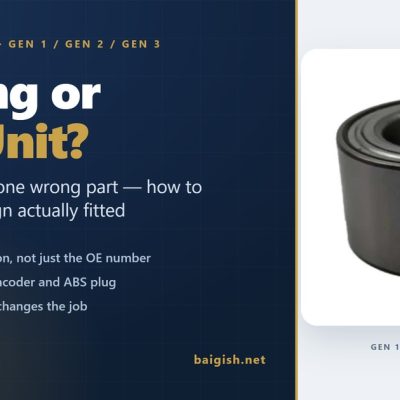
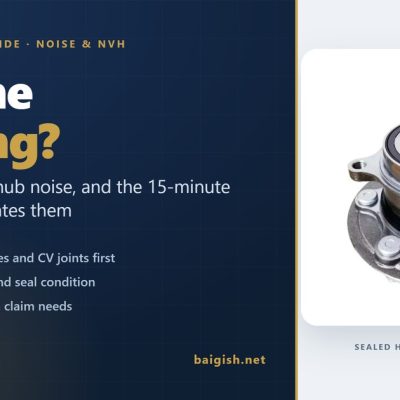
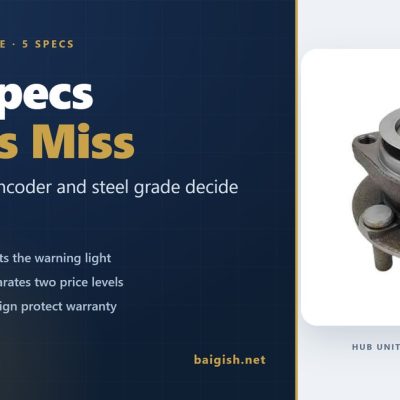
For more on how the generations differ in construction and installation, see our guide to wheel bearing versus hub unit, Gen 1 to Gen 3. If the complaint is noise rather than a lamp, the seven causes and diagnostic checklist covers that path in detail, and the five specifications buyers get wrong is worth reading before you build a catalogue entry.
FAQ
Can I drive with the ABS light on and a worn wheel bearing?
Only to reach a workshop. With ABS disabled, the vehicle loses anti-lock function and electronic brake distribution on some models, which lengthens stopping distance on wet or loose surfaces. More seriously, a bearing worn far enough to disturb the encoder is also worn far enough to seize or to separate under load. A seized front hub unit at road speed is a loss-of-control event, not an inconvenience.
Will a bad wheel bearing always trigger the ABS light?
No. Many bearings are audibly worn for tens of thousands of kilometres while the encoder still reads cleanly, because the pole pattern remains intact and the air gap stays within tolerance. Signal faults appear when play, contamination or mechanical damage reaches the ring. This is why noise and codes should be treated as separate symptoms of the same part.
Does an ABS fault mean I need the whole hub unit?
Not necessarily. If the fault is in the sensor, the connector or the harness, those are separate parts on most vehicles. If the encoder ring is damaged, contaminated or swollen, the ring is part of the sealed bearing on a Gen 2 or Gen 3 unit and the assembly is replaced. The sensor-tip inspection in step 2 is what distinguishes the two cases.
Can a failing hub bearing make the speedometer stop working?
On some vehicles, yes — where the ABS module supplies the speed signal to the instrument cluster. On others the speedometer is driven from the transmission output shaft and will stay steady while ABS is disabled. A steady speedometer is therefore not evidence that the bearing is fine.
How long should the repair take?
Typically one to two hours per corner including the road test, given a hub puller or press, the correct torque figures and a scan tool for the drive cycle. Bolted Gen 3 assemblies are usually faster than pressed Gen 1 or Gen 2 bearings, which need the knuckle removed and the old races drawn out.
Find the Right Hub Unit for Your Market
BAIGISH supplies wheel hub bearing units with integrated ABS encoders for Japanese, Korean, European and American applications, produced under IATF 16949 with SGS testing and more than 70 references held in stock. Every product page lists the OE number, the BAIGISH part number and the applicable models side by side, so the encoder type and the ABS variant can be confirmed before an order is raised.
Send us the OE number, the VIN or the vehicle details, and a photo of the sensor tip and the old unit, and we will come back within 24 hours with the matching part, the specification sheet and a quotation. You can browse the catalogue by vehicle brand — for example Toyota applications or Nissan applications — see the production line, read more in our news and technical articles, or request a quote directly.