




Two suppliers can quote the same OE number and still ship completely different products. One bearing lasts 120,000 km; the other starts humming at 30,000 km and comes back as a warranty claim. For distributors, importers and repair shops, that difference is not a technical detail — it is labour cost, return freight, and the account you lose when a workshop stops trusting your catalogue.
This guide covers the five specifications that decide whether a wheel hub bearing actually works on the vehicle, and the ones buyers most often skip when they compare quotations on price alone.
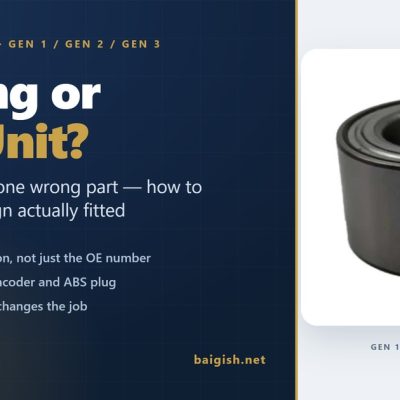
1. Fitment Is More Than Matching the OE Number
The OE number is the starting point, not the answer. Manufacturers supersede numbers, reuse one number across several model years, and split applications by drive axle position, engine variant and whether the vehicle has ABS. A number that is "correct" for a 2014 model can be wrong for the 2016 facelift of the same car.
Before you confirm an order, verify four things: model year range, front or rear axle, ABS or non-ABS, and drive type. Where possible, ask the buyer for the VIN. A supplier who can map VIN to part number — and who publishes a cross-reference from their own part number back to OE numbers — will save you far more time than one who only quotes a price.
At BAIGISH every product page lists the OE number, the BAIGISH part number and the applicable models side by side, so a counter clerk can confirm fitment without calling the sales desk. You can browse by vehicle brand, for example Toyota wheel hub bearings or Nissan wheel hub bearings.
2. The ABS Encoder Decides Whether the Warning Light Comes On
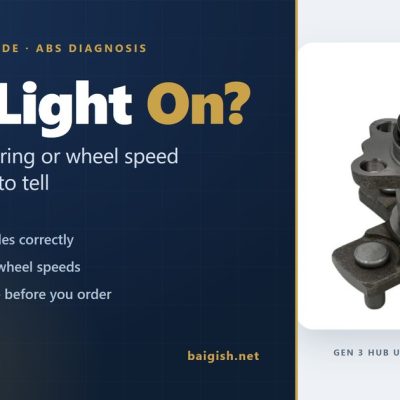
Most modern hub units carry the ABS encoder inside the bearing seal. Get it wrong and the part physically fits, the wheel turns, and the ABS lamp comes on the moment the car moves — often with no fault code that points at the bearing.
Check the encoder type (rubber-bonded magnetic ring versus a metal toothed ring), the pole count, the sensor air gap and the connector shape on integrated harness units. A magnetic encoder that has been pressed in back to front, or a ring with the wrong pole count, will produce an erratic signal rather than no signal — the hardest fault for a workshop to diagnose and the fastest way to get a part returned.
3. Steel Grade and Heat Treatment Separate Two Price Levels
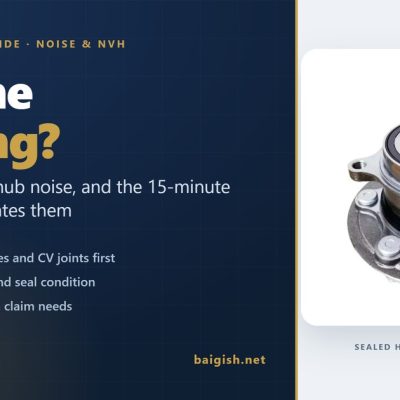
Bearing rings are normally made from through-hardened bearing steel (GCr15 / 100Cr6) at roughly 58–62 HRC. Cheaper units substitute case-hardened low-carbon steel: the surface reads hard on a file test, the core does not, and the raceway starts to spall once it sees real load and road shock.
The flange matters just as much. A forged flange holds hub runout and bolt torque; a casting can deflect under cornering load, which shows up as uneven pad wear or a vibration that no balancing corrects. Ask for the flange material and the runout tolerance in writing — a supplier who cannot answer is telling you something.
4. Preload, Axle Nut Torque and Seal Design
Hub bearings are preloaded at assembly. That preload is set by the internal design, and it is destroyed by the installer who over-torques the axle nut "to be safe", or who reuses a staked nut. Specify the torque figure and the fastening method (staking, caulking, or a nut with a retaining feature) on the product page and in the box, and returns from installation error drop immediately.
Sealing is the other half. A triple-lip seal with the correct grease for the temperature range keeps water and road salt out; a single lip with generic grease will pass a bench test and fail in a winter market. For export to cold or coastal regions, ask for the salt-spray hours and the grease operating range rather than accepting "sealed for life".
5. Test Data, Certification and Traceability
Price comparisons are only meaningful when both sides can produce evidence. A serious supplier will hand over an IATF 16949 certificate, a third-party test report such as SGS, noise and vibration test results, and batch traceability from heat number to carton. Traceability is what lets you answer a customer complaint in 48 hours instead of replacing a whole shipment on suspicion.
| What to confirm | Why it matters | Common mistake |
|---|---|---|
| OE cross-reference + VIN check | Prevents fitment returns | Matching only the model name |
| ABS encoder type and pole count | Prevents ABS lamp and misdiagnosis | Assuming all ABS rings are the same |
| Steel grade and hardness | Decides real service life | Judging by surface hardness only |
| Flange material and runout | Affects vibration and pad wear | Ignoring flange on cheap units |
| Axle nut torque and fastening | Avoids installation failures | Reusing staked nuts |
| Seal type and grease range | Survives water, salt and cold | Accepting “sealed for life” |
| IATF 16949 / SGS reports | Backs your own warranty policy | Buying on certificate photos |
What to Send Before You Ask for a Quotation
- OE number and the vehicle's model year, engine and axle position
- Target quantity per model, and how many models you intend to stock
- ABS or non-ABS, and whether the unit includes the sensor harness
- Packaging requirement: neutral box, your own brand, or barcoded cartons
- Destination market and climate, which sets the seal and grease specification
- Any warranty terms you promise your own customers
With those six points, a quotation becomes comparable. Without them, you are comparing two numbers that describe different products.
FAQ
Can I fit a non-ABS bearing to a vehicle with ABS?
No. Without the encoder ring the ABS module receives no wheel-speed signal and the system is disabled, which is both an inspection failure and a safety problem.
How long should a wheel hub bearing last?
With correct installation and a quality unit, 80,000–150,000 km is realistic. Life drops sharply with over-torqued axle nuts, damaged seals, or a bent flange from a curb impact.
Do you supply custom packaging and private label?
Yes. BAIGISH supplies neutral packaging, custom printed boxes with your brand, and barcoded cartons for warehouse systems. Artwork and barcode format are confirmed before production.
What is the minimum order quantity?
Stock items start at 6 pieces per model, which lets a distributor test a new market without committing to a full container. Mixed-model orders are accepted.
Choosing a Supplier, Not Just a Part
A bearing is a commodity until something goes wrong. What you are really buying is a part number you can defend, a specification you can quote to your own customers, and a supplier who answers when a workshop calls. BAIGISH manufactures wheel hub bearings and wheel bearings for Japanese, Korean, European and American applications, with IATF 16949 production and SGS testing, and ships from a stock of more than 70 models.
Send us an OE number or the vehicle details and we will come back within 24 hours with the matching part, the specification sheet and a quotation. Start from the product catalogue, take a look at the factory, or contact our sales team directly.