




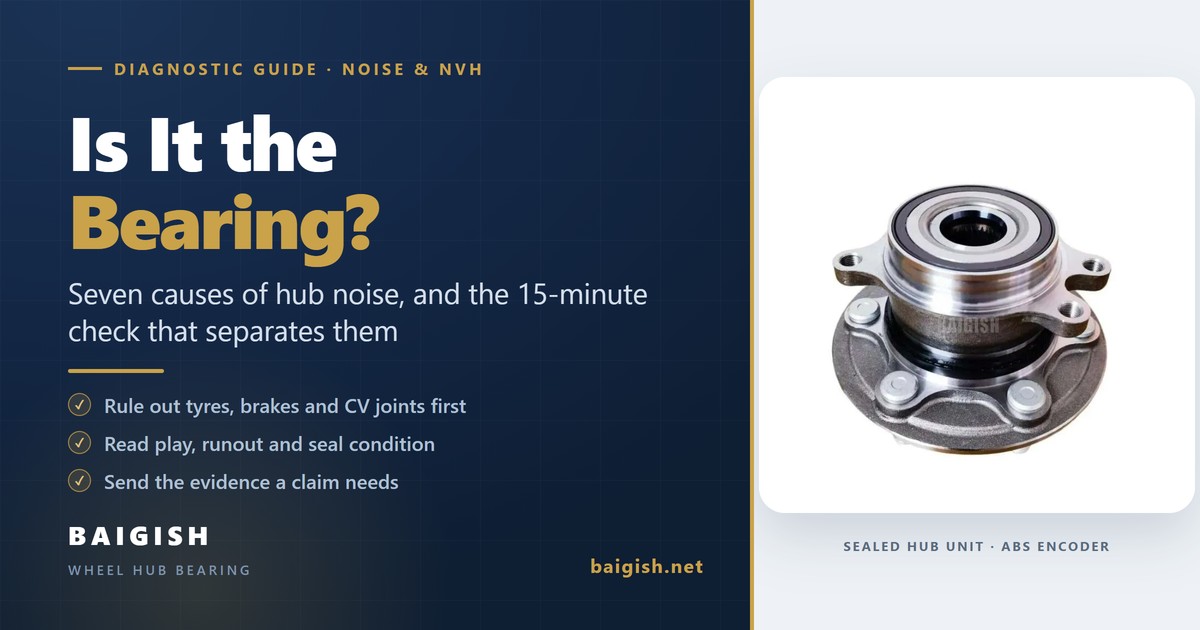
A wheel hub bearing almost never fails in silence. The first sign is usually a hum that starts around 40 km/h, grows into a growl on the motorway, and changes pitch when the driver changes lanes. By the time the vehicle reaches a workshop, the diagnosis is often already written on the job card as "bad bearing" — and that is where the real cost begins. For a distributor or importer, a noise complaint means workshop labour, a replacement unit, return freight and a claim that has to be argued with a factory thousands of kilometres away.
The part itself is rarely the biggest expense. Misdiagnosis is. Warranty desks regularly receive returned hub units that bench-test perfectly within specification, because the noise came from a tyre, a CV joint, a distorted splash shield, or an axle nut that was tightened "by feel". This guide explains how to separate those cases, gives a repeatable bay checklist, and sets out the evidence pack that lets a supplier resolve a claim in one exchange rather than six.
1. First, Rule Out Everything That Sounds Like a Bearing
Hub bearing noise has two defining characteristics: it follows vehicle speed rather than engine rpm, and it changes with lateral load as the vehicle corners. It does not disappear when you shift to neutral, it does not follow a change of road surface, and it does not appear only on full steering lock. Everything else on the car has a different signature.
Use the table below as a first filter before a wheel is removed. Ten minutes of road testing here routinely saves a complete comeback job — and a warranty argument that cannot be won because the returned part is not faulty.
| Noise signature | Most likely source | Fast check |
|---|---|---|
| Speed-dependent hum or growl; louder in one direction of bend | Wheel hub bearing | Sweeping left/right lane changes at 50–70 km/h |
| Rhythmic clicking on full-lock, low-speed turns | Outer CV joint | Figure-eight manoeuvre in a car park |
| Low drone that changes with the tarmac | Tyre tread or cupped tread | Swap wheels front to rear and repeat the same road |
| One scrape or tick per wheel revolution | Brake shield, trapped stone, pad indicator | Spin the wheel by hand on a lift |
| Whine that follows engine rpm in every gear | Transmission or auxiliary drive | Rev the engine in neutral, stationary |
| Rattle over bumps only, silent while rolling | Suspension or loose heat shield | Bounce test and visual inspection of the shield |
One caution on cornering: a bad bearing is usually loudest when it is on the loaded side of the vehicle. A right-side unit therefore tends to grow louder in a left-hand bend, where weight transfers to the outside wheels. Note which direction changes the volume rather than guessing a side from the driver's seat.
2. Seven Root Causes of Wheel Hub Bearing Noise
Once the bearing is confirmed as the source, the character of the noise points to where the failure began. Six of the seven causes below originate before the part reaches the vehicle or during the hour it is fitted — which is exactly why a claim needs evidence rather than just a returned box.
1. Grease breakdown or contamination
A hub unit leaves the factory with a measured quantity of grease formulated for a temperature and speed range. Excessive heat, long storage in a hot container, or dirt introduced during handling breaks the grease down. The rolling elements then run with a marginal film, and a fine, high-pitched whine appears before any measurable wear has occurred. On disassembly the grease is dark, separated or gritty rather than smooth and uniform.
2. Seal failure and water ingress
A nicked seal lip, a seal pressed in slightly skewed, or a lip hardened by age lets water, road salt and fine grit into the raceway. Corrosion pits form on the hardened steel, and the result is a rough rumble that rises with speed and does not smooth out as the bearing warms up. This is the most common failure in coastal and winter markets, and the visual evidence is unmistakable: rust staining, milky or brown grease, and pitting on the raceway.
3. Wrong axle nut torque, or a reused staked nut
Hub bearings are preloaded at assembly. The axle nut sets the clamp load that preserves that preload. Over-torque it with an impact gun and the rolling elements are crushed beyond their design load, generating heat, a low growl and early spalling. Under-torque it — or reuse a nut whose stake has already been punched once — and the joint develops play, producing a loose knock that quickly becomes a droning noise. Both failures are installation faults, and both can be identified from the nut condition and the installer's torque record.
4. A damaged ABS encoder or distorted seal
On modern hub units the wheel-speed encoder is built into the seal. A cracked magnetic ring, a seal distorted by a careless press, or a harness connector left unclipped produces a cyclic noise once per revolution — and usually an ABS warning lamp at the same time. Because the part physically fits and the wheel turns normally, this is often mistaken for a sensor fault and the bearing is replaced twice. Check the encoder face and the connector before condemning the unit.
5. Flange runout after an impact
A kerb strike, pothole or wheel-changing impact can bend the hub flange by a few hundredths of a millimetre. The bearing itself may still be sound, but the flange now runs out of true, so the brake disc rubs once per revolution and the assembly transmits a periodic drone. Fit a new bearing to a bent flange and the noise returns within days. Measure runout with a dial indicator before fitting the replacement, and check the disc for uneven pad wear.
6. A specification that does not match the application
An OE number can cover several model years with different axle loads, ABS systems or engine weights. A unit that is correct for the lighter variant will fit the heavier one, pass a static check, and then run permanently overloaded — producing a progressive growl and early fatigue. Superseded numbers, front/rear differences and ABS versus non-ABS variants cause the same problem. Verifying the VIN and axle position at the quotation stage is far cheaper than investigating a noise complaint later.
7. A genuine manufacturing or preload defect
Real defects do exist: raceway inclusions, incorrect internal preload, a cage damaged during assembly, or heat treatment outside the specified hardness band. They are the minority of noise complaints, and they are also the easiest for a factory to confirm — provided the unit can be traced back to a batch. A defect claim that arrives with a lot code and a retained-sample comparison is normally settled quickly; one that arrives as an anonymous bare unit is not.
3. A 15-Minute Diagnostic Checklist
Standardise this sequence across your workshop network. Consistent observations are what turn a complaint into a claim a supplier can actually act on.
- Road test on smooth tarmac at 30–80 km/h, windows closed, radio off. Record the exact speed at which the hum begins and whether the pitch rises with speed.
- Perform gentle sweeping bends in both directions and note which side increases the volume. Do not use full-lock turns — that tests the CV joint, not the bearing.
- Lift the vehicle safely and spin each wheel by hand, listening at the knuckle with a mechanic's stethoscope or a long screwdriver. A gritty, sandy rumble indicates the raceway; a smooth spin does not yet clear the bearing.
- Rock the tyre at 12 and 6 o'clock, then at 3 and 9. Note any play, but be aware that modern preloaded hub units often show no free play even when noisy — absence of movement is not proof of a good bearing.
- Inspect the seal lip, encoder face, harness connector and axle nut stake. Photograph rust staining, wet grease, a disturbed stake mark or a cracked magnetic ring.
- Reconcile the paperwork: OE number, supplier part number, VIN, axle position, ABS status, fitting date, mileage at fitting and mileage at failure.
Write all six observations on the job card. A claim that arrives with measurements gets a technical answer; a claim that arrives as "bearing noisy, please replace" gets a request for more information and a week of delay.
4. What to Send a Supplier With a Warranty Claim
A factory cannot assess a defect from a description. It has to connect the failed unit to a production batch, a heat number and a set of installation conditions. Send these eight items in the first email, not after three rounds of follow-up:
- The OE number and your supplier's part number, plus the VIN or full vehicle description (year, engine, axle position, ABS or non-ABS)
- The batch or lot code from the carton label or the laser marking on the flange
- Clear photographs of both faces of the unit, the seal, the encoder ring, the flange face and the box label
- A short video of the wheel spinning on a lift with audio, plus an in-cabin recording of the road-test noise
- Fitting date, mileage at fitting and mileage at failure
- The axle nut torque used, whether a new nut was fitted, and who carried out the installation
- Operating conditions: climate, road salt, flooding, typical payload, towing or commercial use
- The six-point job card from the checklist above
| Claim item | What it lets the factory do | If it is missing |
|---|---|---|
| Batch / lot code | Pull the retained sample, heat-treatment record and inspection report | The unit cannot be linked to a production run |
| Torque and nut details | Rule installation preload damage in or out immediately | The most common cause stays unresolved |
| Photos of seal and encoder | Identify water ingress, impact damage or seal distortion | Requires a physical return before any answer |
| Vehicle and axle details | Confirm the specification matched the application | A fitment error looks like a product defect |
The batch code is the single most valuable line in that list. With it, a supplier can compare the complaint against the retained sample and the process records from the same run. Without it, even a clearly defective unit becomes a discussion about photographs. Ask your supplier to confirm, before the first order, that lot coding is printed on both the carton and the part.
5. Preventing Noise Complaints Before the Container Ships
Most of the seven causes above are decided at the purchasing stage, not in the workshop. Specifying the right unit and documenting it costs almost nothing; investigating a noise complaint after the goods have been distributed costs a great deal.
Start with fitment and construction. Our guide to the five specifications buyers get wrong covers OE cross-references, ABS encoder type, steel grade and heat treatment, preload and test data in detail. Ask for the grease operating range, the seal design and the salt-spray test hours in writing. Require a current IATF 16949 certificate, a third-party test report such as SGS, and batch traceability from heat number to carton — and check that the certificate belongs to the factory that actually makes the part.
Match the specification to your market. A unit that performs well in a dry climate can fail within a winter or two where roads are salted, and a catalogue built for passenger cars will not survive commercial payloads. Confirm packaging that protects the seal faces during a long sea freight, and specify neutral cartons, your own brand, or barcoded labels before production starts. You can see how the production and inspection line is organised, then browse the catalogue by vehicle brand — for example Toyota applications or Nissan applications — and check that OE number, part number and applicable models are listed together before you order.
FAQ
Does wheel hub bearing noise get louder when cornering?
Usually yes, and that is a useful diagnostic sign. Because cornering transfers load to the outside wheels, a worn bearing on the loaded side becomes louder. If the noise is unchanged in both directions, look harder at tyres, brakes and the drivetrain before ordering a bearing.
Can a brand-new hub bearing be noisy straight after fitting?
It can, but treat it as an installation or fitment issue first. Check the axle nut torque and whether a new nut was used, measure flange runout, verify the encoder and connector, and confirm the OE number against the VIN. A new unit that is noisy from the first kilometre is far more often a setup problem than a manufacturing defect.
Is it safe to keep driving with a noisy hub bearing?
Have it inspected promptly rather than waiting for the noise to become loud. As wear advances the unit can develop play, generate significant heat and, in extreme cases, seize or allow the wheel assembly to move. Until it is checked, avoid high speeds and heavy loads, and do not treat a quiet day as a repair.
Will a claim be rejected if the box or batch code is missing?
Not automatically, but it becomes much harder to resolve. Without the lot code the factory cannot compare the unit with retained samples or process records, so it will usually ask for the physical part to be returned before making a decision. Keeping carton labels for the warranty period is one of the cheapest insurance policies a distributor can put in place.
Work With a Supplier Who Can Close the Claim
BAIGISH builds wheel hub bearings and wheel bearings for Japanese, Korean, European and American applications under IATF 16949 production, with SGS testing and more than 70 models held in stock. Every product page lists the OE number, the BAIGISH part number and the applicable models side by side, so fitment can be confirmed before a wheel is ever removed — and every carton carries a lot code that lets us trace a complaint back to the production run.
If you are dealing with a noise complaint or planning a new stocking programme, send us the OE number, the vehicle details and a short description of the symptom. We will come back within 24 hours with the matching part, the specification sheet and a quotation. You can start from the product catalogue, read more in our news and technical articles, or request a quote directly.