




A counter clerk searches "wheel bearing for a 2015 Corolla" and gets three different answers: a bare double-row bearing, a flanged unit, and a complete hub assembly with an ABS lead. All three are sold under similar names, all three look plausible in a catalogue, and only one fits the car. Order the wrong one and the vehicle leaves the workshop on a trailer — not because the part was defective, but because the catalogue used the wrong word.
For distributors and importers, that distinction decides how you build a catalogue, how you answer an OE enquiry, and how much of your returns bill is caused by fitment rather than quality. This guide explains what actually separates a traditional wheel bearing from a Generation 1, Generation 2 or Generation 3 hub unit, and the checks that stop a mis-order before the carton is shipped.
1. Why the Names Cause So Many Wrong Orders
In the trade, "wheel bearing" originally meant the bearing itself: a double-row angular-contact ball bearing or a paired tapered roller bearing pressed into the steering knuckle, with the hub and flange supplied separately. "Hub unit", "hub assembly" and "wheel hub bearing" describe an integrated assembly in which the bearing, sealing, preload and often the mounting flanges and ABS encoder are built into one sealed-for-life component.
The problem is that catalogues, buying groups and even OE parts systems use the terms interchangeably. A single vehicle nameplate can appear under both headings, and a number that looks like a bearing cross-reference can in fact point to a complete hub assembly. At BAIGISH we keep the two families separate in the product catalogue — traditional Wheel Bearings and integrated Wheel Hub Bearing Units — precisely so a buyer can see which construction they are ordering before they compare part numbers.
"Generation" is an industry shorthand, not an official OE numbering system. No manufacturer stamps "Gen 3" on the box. It is a useful way to describe how much is integrated into the assembly, but the OE number and the VIN remain the only reliable fitment authority.
2. The Three Generations at a Glance
| Generation | What is integrated | How it mounts | Where you meet it |
|---|---|---|---|
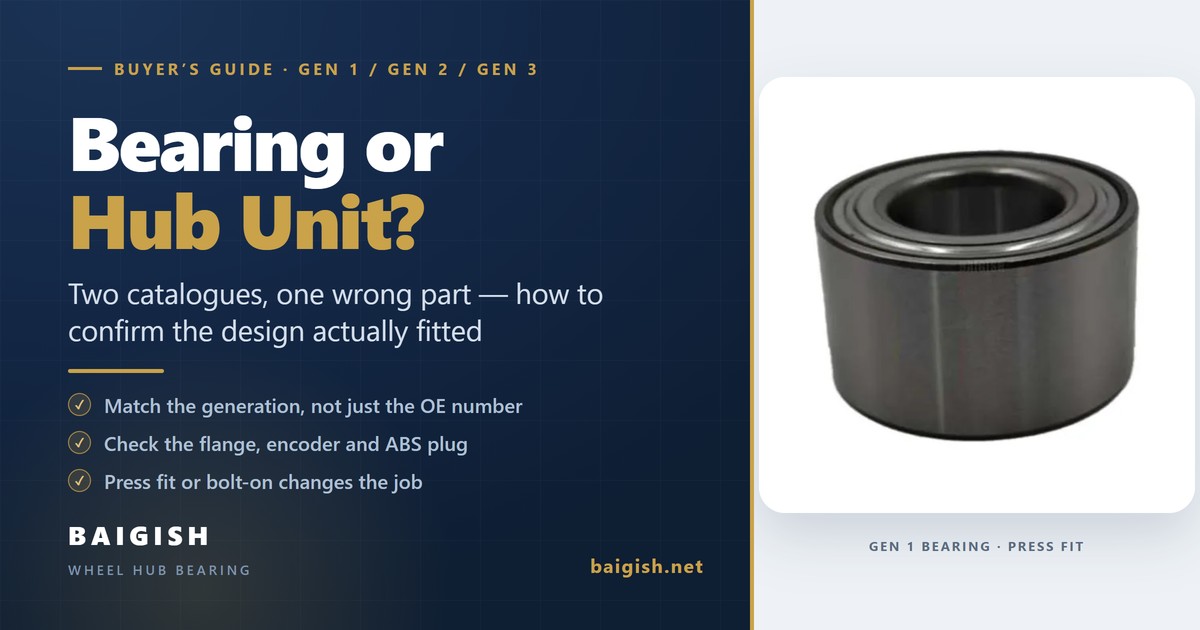
| Gen 1 | Bearing only — double-row ball or paired tapered rollers, seals and grease | Pressed into the steering knuckle; hub and flange are separate parts | Older vehicles, some rear axles, light commercial applications |
| Gen 2 | Bearing plus one mounting flange, with preload set at the factory | Flange bolts to the knuckle; the wheel hub still locates on the inner ring | Commonly found on front axles from the 1990s and 2000s |
| Gen 3 | Bearing plus inner and outer flanges, wheel studs and usually an ABS encoder | Bolts directly between the knuckle and the wheel / brake disc; no press needed | Most modern passenger cars, SUVs and crossovers |
The trend across all three is the same: more of the assembly is set and sealed at the factory, so less can go wrong in the workshop. It also means less can be adjusted afterwards — which is why installation records matter so much when a claim is filed.
3. Gen 1: The Bearing Itself
A Gen 1 unit is a bearing and nothing else. It is pressed into the knuckle bore, the hub is drawn into the inner rings, and the correct internal preload is set with the axle nut. That sequence requires a press, the right adaptors, a torque wrench and a new staked nut. It also leaves three separate opportunities for error: a bearing pressed in skewed, a hub drawn in without supporting the inner ring, and a nut tightened "by feel".
When sourcing Gen 1 parts, confirm the rolling element type (tapered roller versus double-row ball), the seal design, and whether the kit includes the circlip, oil seal or nut that the application requires. Selling a bearing without the small parts needed to fit it is a classic source of a comeback job that has nothing to do with bearing quality. Because preload and seals are the failure points here, this is also the generation most often associated with noise complaints — our wheel hub bearing noise diagnosis guide covers those causes in detail.
4. Gen 2: One Flange, Factory-Set Preload
Gen 2 adds a flange to the outer ring, so the assembly bolts to the knuckle instead of being pressed into it. Internal preload is set and locked at the factory, which removes one of the biggest installation variables. The wheel hub, brake disc and drive flange still locate on the inner ring, so the unit is not yet a complete bolt-on hub.
Fitment checks for Gen 2 concentrate on the flange: bolt hole count, pitch circle diameter, the spigot diameter that centres it in the knuckle, and the offset between the flange face and the brake disc mounting plane. On ABS applications the tone ring may be part of the outer assembly, so a non-ABS version of an otherwise identical flange will still leave the warning lamp on.
5. Gen 3: The Complete Hub Unit
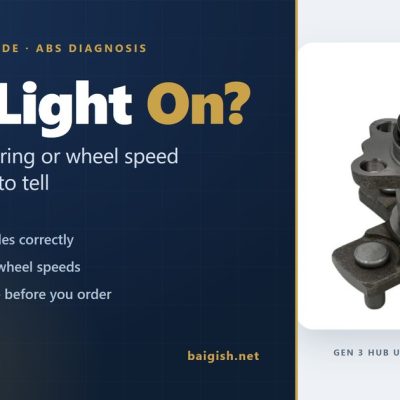
Gen 3 is what most people now mean by a wheel hub bearing. Two flanges are integrated: the outer flange bolts to the knuckle, the inner flange carries the wheel studs and the brake disc. The ABS magnetic encoder is built into the seal, and on many applications the sensor and harness are supplied with the unit. Preload, sealing and grease are all factory-set. Fitment is a bolt-on operation with a torque wrench rather than a press.
That integration is also why the specification list is longer. Confirm ABS versus non-ABS, the encoder type and pole count, the sensor connector shape and harness length, the flange PCD and stud count, and whether the unit is for a driven or non-driven axle. Some left and right units are not interchangeable, and a single model year can split by engine or by whether the vehicle has stability control. The majority of the hub units in our catalogue fall into this generation, and our guide to the five specifications buyers get wrong goes deeper on encoder, steel and test data.
6. What This Means for Your OE Enquiry and Your Catalogue
Never answer an enquiry from the model name alone. Manufacturers supersede OE numbers, reuse one number across several model years, and split applications by axle position, ABS and drive type. A number that is correct for a 2014 car can be wrong for the 2016 facelift of the same nameplate. Ask for the VIN, and ask your supplier to map it back to a current OE cross-reference.
| Check before ordering | Why it matters | What to ask the supplier |
|---|---|---|
| Generation and mounting type | Decides whether a press, adaptors and separate seals are needed | A side-view drawing or photo of the actual unit |
| ABS encoder and harness | A wrong encoder leaves the ABS lamp on even when the part fits | Encoder type, pole count and connector shape |
| Flange PCD, stud and bolt count | The most common reason a unit physically will not bolt up | Dimensions confirmed against the old unit |
| Axle position and side | Some left / right and front / rear units are not interchangeable | Fitment list by VIN, not by model name |
| OE supersession history | An old number may map to a different construction today | Current cross-reference from their part number back to OE |
A supplier who publishes OE number, their own part number and the applicable models together lets a counter clerk resolve most of this without a phone call. A supplier who only quotes a part number leaves the fitment risk with you.
7. How to Identify the Unit That Is Actually on the Vehicle
- Read the number on the old part. Photograph the OE or part number stamped or laser-marked on the flange, seal face or bearing outer ring before it is discarded.
- Look at how it mounts. A unit that bolts straight to the knuckle through a flange is Gen 2 or Gen 3; a bare bearing pressed into a bore with a separate hub is Gen 1.
- Check for ABS. Look for a sensor lead, a connector, or a magnetic encoder ring on the inboard seal, and photograph the connector face.
- Note the axle and side. Record front or rear, driven or non-driven, left or right, and whether the hub carries the brake disc.
- Send the VIN and the photographs, not just the model name. Include mileage and, if it is a comeback, the original invoice and part number.
Five minutes with a phone camera at the vehicle prevents more wrong orders than any amount of catalogue browsing afterwards.
8. Installation Differences That Affect Warranty
Each generation fails differently when it is fitted badly. Gen 1 is sensitive to press alignment and axle nut preload. Gen 2 removes the press but still depends on the flange being seated flat on a clean knuckle face. Gen 3 removes most of the adjustment, yet over-torquing the axle nut, reusing a staked nut, distorting a seal during handling or fitting a magnetic encoder back to front will still produce early noise and an ABS fault.
None of those are manufacturing defects, and a factory cannot confirm that from a returned part alone. Keep the installer's torque figure, the new-nut record and the job card observations with the claim. Our noise diagnosis guide sets out the exact evidence pack that lets a supplier close a claim in one exchange.
FAQ
Can a Gen 3 hub unit replace a Gen 1 bearing?
Not as a like-for-like swap. The knuckle, hub, brake disc offset and mounting method are different, and the ABS system may have no way to read the new unit. Replacing one with the other means a complete assembly change, not a part substitution. Match the construction the vehicle was built with.
Is a wheel hub bearing the same as a wheel bearing?
No. A wheel bearing is the bearing itself; a wheel hub bearing (hub unit) is a sealed assembly that contains the bearing plus flanges, and usually the ABS encoder. The terms are often used loosely, which is exactly why fitment should be confirmed by OE number and VIN rather than by name.
Why do two suppliers quote different parts for the same OE number?
Usually because of a supersession, an ABS / non-ABS split, or a model year and axle position split that one catalogue handles and the other does not. Ask both for their cross-reference and for the VIN mapping, then compare the physical construction: flange, encoder and bolt pattern.
Do I need a hydraulic press to fit a Gen 3 unit?
No press is needed for the unit itself — it bolts on. You will still need a torque wrench, a new axle nut where specified, and occasionally a puller or hub separator if the old flange has corroded onto the knuckle. Follow the vehicle maker's torque and fastening method rather than an impact gun.
Find the Right Unit for Your Market
BAIGISH manufactures both traditional wheel bearings and integrated wheel hub bearing units for Japanese, Korean, European and American applications, under IATF 16949 production with SGS testing and more than 70 models held in stock. Every product page lists the OE number, the BAIGISH part number and the applicable models side by side, so you can confirm construction and fitment before you raise an order.
Send us the OE number, the VIN or the vehicle details and a photo of the old unit, and we will come back within 24 hours with the matching part, the specification sheet and a quotation. You can browse the catalogue by vehicle brand — for example Toyota applications or Nissan applications — see the production line, read more in our news and technical articles, or request a quote directly.