




A catalogue number is the most valuable piece of data on an invoice, and it is also the one most often guessed. When a distributor orders a front wheel bearing against a customer's worn part, the question is never "is there a bearing that fits" — several do. The question is which number describes the same part: the same dimensions, the same internal design, the same sealing, so that the box that arrives bolts on without a surprise at the bench.
That is what a cross-reference does. It connects one manufacturer's OE number to the equivalent numbers used by other makers and by the aftermarket. Done well, it shortens sourcing, keeps orders consistent across markets and protects you from the most expensive mistake in the bearing trade: a part that measures right and fits wrong. This guide explains how OE numbers for wheel bearings are structured, how to read them, and how to verify a match — using two of the most requested front-axle applications we ship: the VW 180407625 and the Toyota 90369-45003.
1. What an OE Number Actually Identifies
An original equipment number is a part number in the vehicle manufacturer's own catalogue. It identifies a part to a specification — dimensions, materials, tolerances, sealing, and often the supplier that built it. It does not identify a brand. The same physical bearing may sit behind a dozen OE numbers across the VW, Audi, Seat and Skoda catalogues, because the group assigns a number per application, not per part.
For wheel bearings the practical consequence is simple: you cannot order from the vehicle registration alone. One platform uses one bearing family across several model years and several brands, and the same physical part appears under numbers that look completely unrelated. The OE number, the measurements and — where fitted — the VIN are the only authorities that decide fitment.
2. Reading the Digits: How Bearing OE Numbers Are Built
The two numbering systems in this guide behave differently, and knowing the pattern helps you spot a wrong number before you pay for it.
VW group numbers start with a model prefix. On the Golf IV platform the prefix 1J0 marks parts developed for that car; the middle section (407625) identifies the part group — front wheel bearing; and a letter suffix marks a running revision: 1J0407625, then 1J0407625A, 1J0407625B, 1J0407625C. A suffix usually means a detail was improved — seal, encoder ring or packaging — while the dimensions stayed the same. A short number and its lettered siblings therefore often cross-reference to the same bearing.
Toyota numbers encode the part family and size. The 90369- prefix covers wheel bearings, and the digits that follow reveal the bore: 90369-45003 is a 45 mm bore, which the full industry designation DAC4584W-1CS81 confirms — 45 mm inner, 84 mm outer, 40 mm wide. Suffix variants such as 90369-45004 and 90369-45005 cover the same family with detail changes, and 90080-36193 is Toyota's older 90080-series reference for the same part.
| System | Structure | What the digits tell you |
|---|---|---|
| VW / Audi / Seat / Skoda | Model prefix + part group + revision letter | 1J0407625C: Golf IV platform, front wheel bearing group, revision C |
| Toyota / Lexus | Family code + size code | 90369-45003: wheel bearing family, 45 mm bore |
| Aftermarket (DAC) | DAC + bore + OD + width + seal code | DAC4584W-1CS81: 45 × 84 × 40, sealed, with design details |
3. Worked Example: VW 180407625
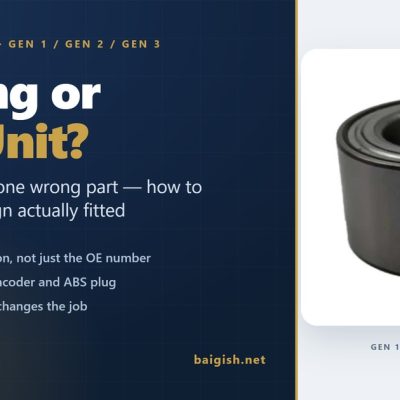
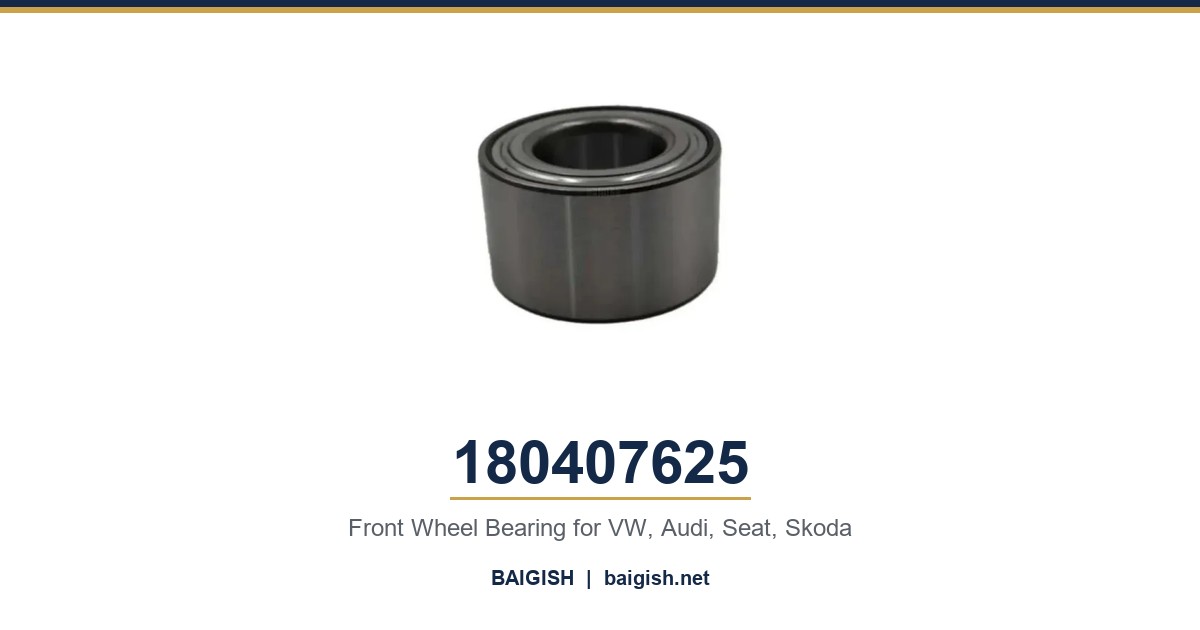
The VW front wheel bearing for the Golf IV / Bora / New Beetle platform — also fitted to the Audi A3 8L and TT 8N, Seat Leon 1M and Toledo II, and the Skoda Octavia I — is a double-row sealed ball bearing pressed into the knuckle, with no hub flange. It carries one of the longest cross-reference chains in the European aftermarket, which is why it is quoted so inconsistently.
Our 180407625 front wheel bearing (40 × 74 × 40 mm) is listed under the full OE set: 180407625 / 180407625A, 1J0407625 / 1J0407625A / 1J0407625B / 1J0407625C, with cross-references 1J0498625, 1J0498625A and 1J0598625 covering the related axle-nut and bearing-kit numbers buyers frequently mix in. One bearing, four brands, a dozen catalogue numbers — and a single correct part.
4. Worked Example: Toyota 90369-45003
The Toyota side shows how one size code reaches across an entire model range. The 90369-45003 (45 × 84 × 45 mm) fits the front axle of the Camry ACV30 / ACV40, Previa and Estima ACR30 / CLR30, Alphard, Kluger and Highlander, Sienna and Avalon, plus Lexus ES300 / ES330 / ES350 and RX300 / RX330 / RX350. That is one bearing serving more than a dozen applications across two brands.
Our 90369-45003 front wheel bearing (45 × 84 × 45 mm) lists the complete chain: OE 90369-45003 / 9036945003 / 90369-45004 / 90369-45005 / 90080-36193, with aftermarket cross-references 90369-T0007, 90363-W0001, 90363-C0002, 90520-77001 and the DAC industry numbers DAC4584W-1CS81 and DAC45840045. When a customer quotes any of these, the same box answers.
5. A Verification Workflow That Prevents Mis-Orders
Catalogue data is a strong first signal, but a shipped bearing is a commitment. Before confirming any order where the number chain is long or the customer quoted from memory, run this four-step check:
Step 1 — Measure the old part. Bore, outside diameter and width with a caliper, to the tenth of a millimetre. A 45 × 84 × 45 bearing will not accept an 84 mm OD guesswork order; width errors are the most common miss.
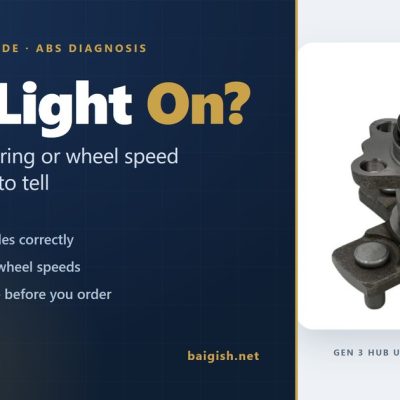
Step 2 — Confirm the design type. A pressed-in bearing without a flange (VW Golf IV) and a bolt-on hub unit (many later Toyota platforms) are not interchangeable, even when the rolling element dimensions match. Check whether the magnetically encoded ABS ring is part of the bearing, because this single detail decides whether the ABS light returns after fitting.
Step 3 — Compare suffix letters. Pull the customer's number with its suffix, not from memory. Where the suffix only marks seal or packaging revisions, the parts are interchangeable; where it marks a change from bearing-only to bearing-with-ring, they are not. If in doubt, quote both numbers to your supplier and let the factory confirm from the drawing.
Step 4 — Check the returning evidence. Ask for a photo of the worn bearing with its face markings and the box label. Ninety per cent of cross-reference disputes close with one photo, because the markings print the industry designation in full.
6. Where Cross-References Go Wrong
Three mistakes account for most mis-ordered bearings we see. First, sizing from the middle: a customer measures the outer diameter, finds a bearing a millimetre off, and assumes a press fit will absorb it. It will not — the knuckle bore is machined to a tolerance, not to a repair shop's calipers.
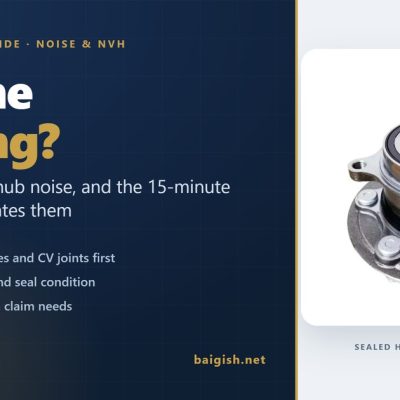
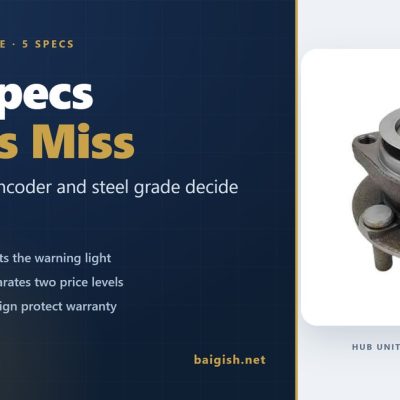
Second, mixing hub units and bare bearings: Gen 1, 2 and 3 assemblies share some dimensions with plain bearings, but flange bolt patterns and sensor layouts differ, and forcing the "close" number into stock leads straight to a comeback.
Third, trusting a single online lookup: aggregator cross-references copy each other's errors, and one wrong entry replicates across a dozen catalogues within a season. Always verify the final number against the OE reference or a supplier that lists the full chain openly. Bearing manufacturers such as NSK publish application data that can confirm a design family before you commit to an order.
If you keep one habit from this guide, keep this: order by the number chain, verify by the measurements, and buy from a source that publishes its cross-references in full. That is how we list every bearing in our product catalogue — OE numbers, cross-references, applications and dimensions on one page — so a buyer can confirm a match in minutes instead of sending three emails. For the two applications above, the VW 180407625 and Toyota 90369-45003 product pages carry the complete chains, and our bearing selection guide covers the specification questions that come before the cross-reference.